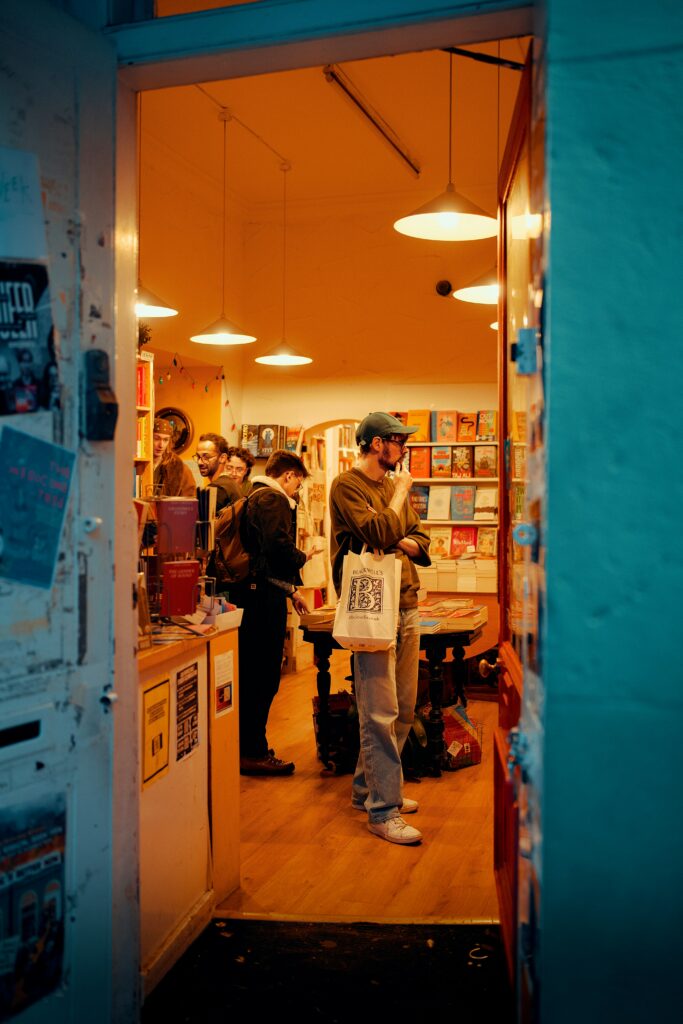
A chain bookstore looks about the same in Lisbon as it does in Chicago. An independent one almost never does. Someone local chose the front table, the languages on the spines, and the flyer by the register for Thursday’s poetry night. That makes independent bookstores one of the cheaper ways for a traveler to see what a city reads, argues about and is proud of, provided you treat them as a neighborhood to wander rather than a single stop to tick off.
Find where independent bookstores cluster
Bookshops tend to gather near universities, old publishing quarters and secondhand markets, where one shop’s customers drift into the next. Tokyo’s Jimbōchō is the textbook case. According to Atlas Obscura, the district is said to hold hundreds of shops. Many are devoted to a single subject, such as philosophy, art or rare antiquarian books, and set bargain bins out on open-air shelves. At the other end of the scale sits Hay-on-Wye, a Welsh town of 1,675 people at the 2021 census. It supports more than twenty bookshops and is known as the National Book Town of Wales.
To find a cluster somewhere unfamiliar, search a map app for “bookstore” in the local language as well as English (librairie, livraria, Buchhandlung, librería) and notice where the pins bunch up. In the United States, the IndieBound finder searches by city or ZIP code. It lists only American Booksellers Association members, though, so treat it as a starting list rather than a census.
It’s tempting to build a whole afternoon around the most photographed shop in town. An hour in its line is an hour not spent in the three shops down the street.
Read the shelves for language
A store’s language mix tells you who it serves. A wall of English titles points to students, expats and visitors. Local originals shelved beside their translations show what the city sends out into the world. Atlas Obscura points English readers in Jimbōchō toward Kitazawa, Isseidō and Sūbunsō, which helps. Much of the district’s character, though, lives in the shops whose spines you can’t read.
Unfamiliar titles are no reason to walk past. Picture books, cookbooks, photography and local maps work in any language, and they often make the most telling souvenir in the room. For something to read, ask whoever is at the counter which local writer they’d hand a visitor in translation. Their answer tends to be more personal than a staff-picks card. The bestseller you could buy at your home airport can stay on the shelf.
Time a visit to the events calendar
Readings, launches and signings are when locals show up, and many cost nothing to attend. Check the shop’s own events page, newsletter or social accounts the week you arrive, since small venues may post late or change plans. Harvard Book Store is a typical example, with each event listed by date and time.
In the U.S., Independent Bookstore Day lands on the last Saturday in April. The American Booksellers Association held the 2026 edition on April 25. Hay-on-Wye also hosts the annual Hay Festival. Confirm its dates on the festival’s own site before you plan around them.
Big book days pack small rooms, and popular free readings may require an RSVP. Also check what language an event is in. A poetry night in a language you don’t speak can still be a fine way to hear a city, as long as you knew that going in.
Check the small practical things
Independent shops keep their own hours. Some close one weekday or open late, and specialist secondhand dealers can be the hardest to predict. Check the shop’s site or a current map listing shortly before you go rather than trusting an older guide. Ask before taking photos, too. Atlas Obscura notes that some Jimbōchō stores forbid photography inside, and the courtesy travels well. Books are also heavy. A slim paperback or a single print packs more easily than a stack of hardcovers, and it’s worth asking at the counter whether the shop ships overseas.
On the way out, give the noticeboard by the door a minute. Between the language-exchange flyers, the choir auditions and a reading series nobody advertised online, it’s often the most honest guide to what the neighborhood is up to.