Stand in an old European square long enough and you’ll notice the fountain isn’t doing much that looks useful. Nobody fills a bucket. Pigeons drink, a child leans too far over the rim, someone photographs the whole thing from the steps. Yet public fountains were rarely built only to be admired. Many began as plumbing, picked up a civic message along the way, and ended up as art. Plenty managed all three at once.
The water had to come out somewhere
The Romans make a sensible starting point, because they treated the street fountain as the final stop in a long piece of engineering. A Lund University study of Pompeii traces water from the aqueduct into raised water towers. From there, pipes carried it on to street fountains, public baths, private houses and workshops. How each line was laid depended on distance and on the drop in height between tower and user.
That list doubles as a social map. A private connection was presumably a mark of means, though the study’s outline doesn’t spell that out. The household without one walked to the basin on the corner. The public fountain was the part of the system meant for people with no supply of their own.
Paris kept its fountain on the books
Medieval Paris adds paperwork to the plumbing. The city’s water utility, Eau de Paris, records that the Maubuée fountain is named in letters patent issued by King Charles VI in 1392. The name translates loosely as “bad steam” or “bad laundry,” which hardly sounds like a boast. What stands there now is not the medieval structure. It dates from 1733.
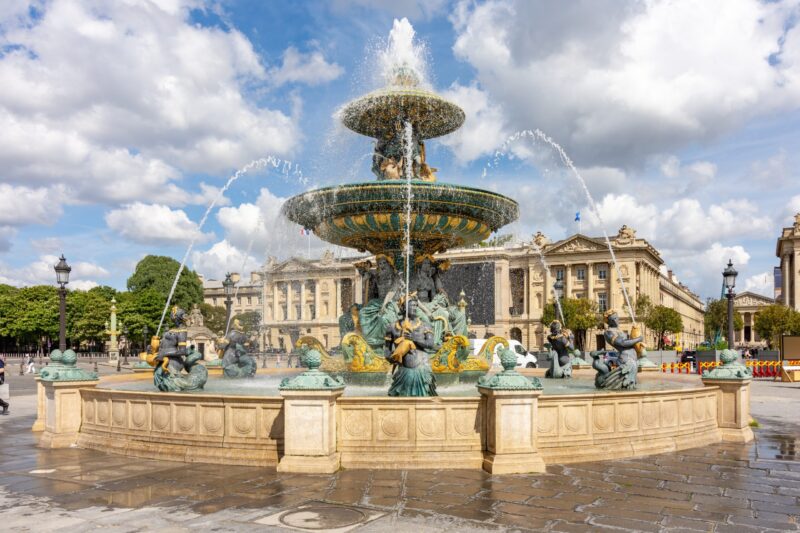
What the record does show is persistence. A fountain mentioned in a royal document in the 14th century was still worth rebuilding more than three centuries later. Why so many fountains gathered in markets and squares is partly interpretation. Even so, the logic is hard to miss: water mattered most where the whole town already came.
Forty statues the water didn’t need
Nuremberg’s Schöner Brunnen, the “Beautiful Fountain,” makes no secret of its ambitions. A historical marker dates it to roughly 1385–96 and credits a master stonemason named Heinrich, followed by “Beheim” and a question mark. That small admission of doubt is more candor than most plaques offer. The marker counts 40 sculptures and ranks them among the city’s most important 14th-century art.
Nobody needed 40 figures to deliver water. A fountain that everyone passed was simply the most visible place a prosperous city could put its wealth, piety and taste.
Rome staged the arrival of water
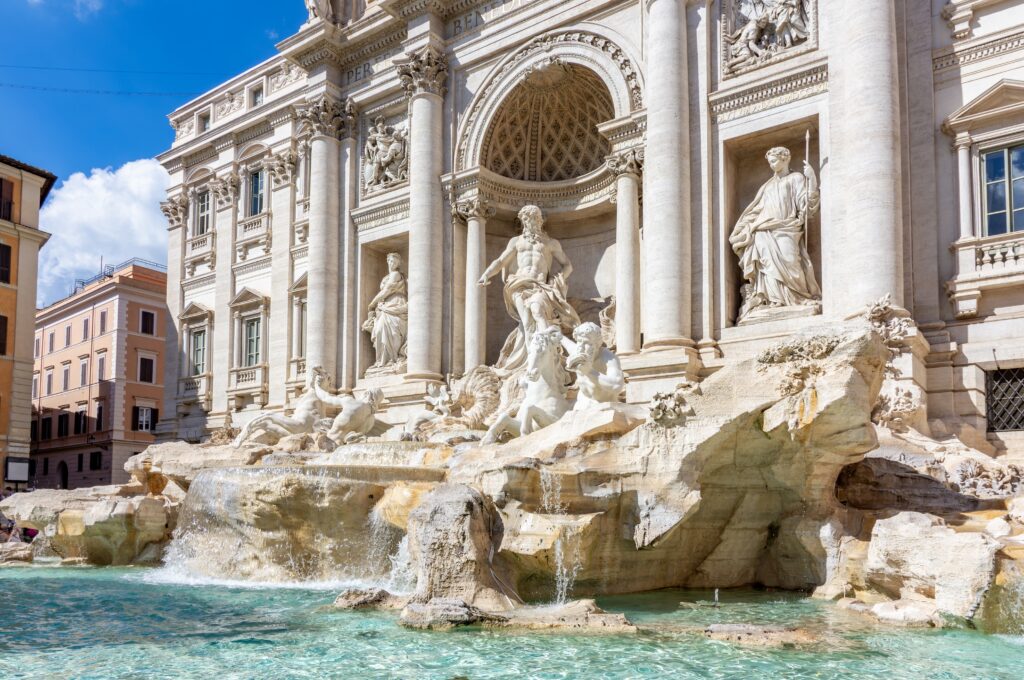
The Trevi Fountain stacks every motive on top of the others. It marks the end of the Aqua Virgo, an aqueduct completed in 19 BC, according to a Rome visitor guide. The Baroque front arrived some 17 centuries later. Nicola Salvi designed it, work ran from 1732 to 1762, and Pannini completed it. Its subject is the taming of water. The aqueduct’s name is attached to a legend, and a legend is all it is: a young girl supposedly guided thirsty soldiers to the spring.
Ancient engineering underneath, theater on top. The message reads plainly either way. This water is here because someone powerful brought it.
Public fountains as public health
By the 19th century the practical purpose was back, and it was urgent. Samuel Gurney and Edward Wakefield were behind what Historic UK describes as London’s first drinking fountain, opened in 1859 at St Sepulchre-without-Newgate. At its busiest, about 7,000 people a day drank from it. Their organization, the Metropolitan Drinking Fountain and Cattle Trough Association, meant the second half of its name literally.
Paris took its own turn after the siege of 1870–71. Eau de Paris notes that Sir Richard Wallace gave the city 50 drinking fountains, the first installed in 1872. They were small and practical, and they were still ornamental. By then, public water in Paris was expected to look like it belonged to the city.
The plain spout and the Baroque spectacle seem like opposites, but both settle the same matter: who gets water, and where. A public fountain is the one stretch of the pipe a city wanted you to see.