The keys are always somewhere. That’s the trouble. They might be in yesterday’s coat, on the kitchen counter under a pile of mail, or in the bag that got dropped by the couch. An entryway landing zone deals with one very specific morning problem.
It gives the handful of things you carry in and out every day one predictable place to stop. You don’t need a mudroom for it. A wall, a couple of hooks, and a little restraint will do.
Why the morning scramble starts at the door
Things seem to go missing less from where they’re kept than in transit. It happens in the distracted 10 seconds after you walk in juggling groceries and a ringing phone. A 2017 Pixie survey tried to put a number on the hunting. Respondents estimated they spend about 2.5 days a year looking for misplaced things, and 28% said they lose their keys at least once a week.
Take the figures with some salt. Pixie sells item trackers, and the numbers are people’s guesses from memory, not a stopwatch. Still, the pattern will sound familiar to anyone who has patted down three jackets at 7:45 a.m.
How a landing zone works with your habits
The point isn’t tidiness for its own sake. The front door already shows up in your day at least twice, whether you plan for it or not. Psychologists Wendy Wood and David Neal reviewed a body of research in a 2007 paper that puts context at the center of habit. Their argument is that repeated actions become tied to the places and situations where they keep happening.
Applied to a hallway, the door itself can act as the cue. Put the hook right beside the latch, and hanging your keys has a decent chance of becoming something your hands do on the way in. Put the designated spot in a drawer across the room, and it’s competing with the couch. The couch usually wins. Distance is friction, so shrink it.
What a minimal entryway landing zone actually needs
Start with what leaves the house daily and nothing else:
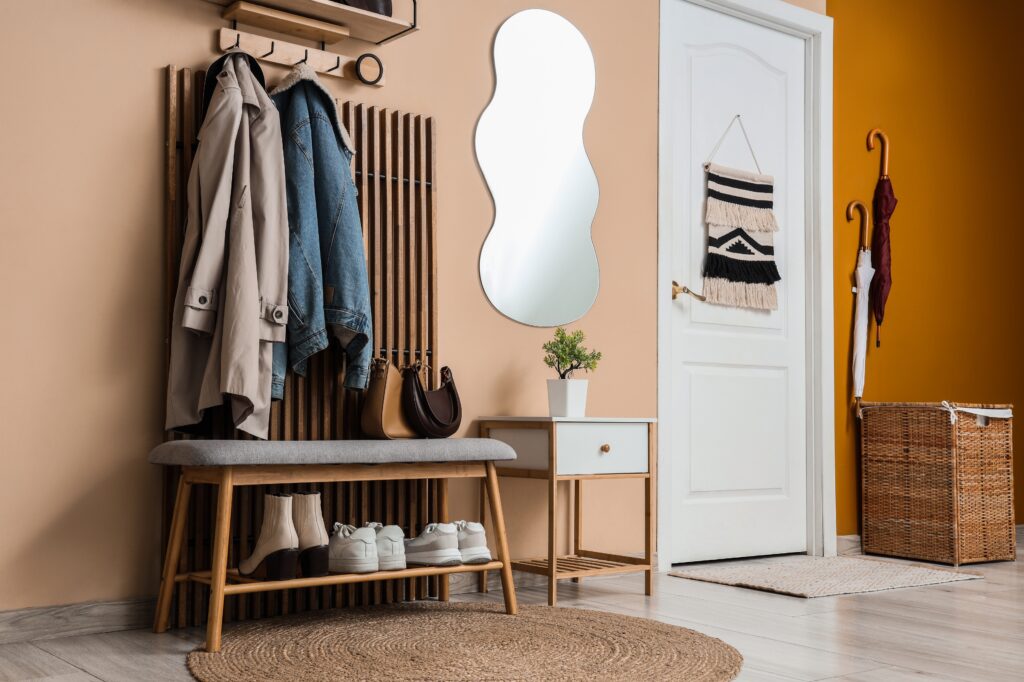
- One spot for keys. A hook or small tray at hand height, close to the door handle.
- One place for the everyday bag. A sturdy hook works. So does a corner of the floor, honestly, as long as it’s always the same corner.
- A mat, ideally two. A University of Georgia extension guide summarizes EPA advice for an entry system: a scraper-style mat outside and an absorbent one just inside to catch soil and water.
- A limit on shoes. One pair per person at the door is plenty. The EPA suggests taking shoes off or wiping away soil before coming inside, so dirt that may contain lead stays out.
- An “out” spot. A single hook or basket for the library book, the return package, the lunch bag. Anything that needs to leave sits where you can’t walk past it.
Feel free to skip the console table, the decorative bowls, and the elaborate mail-sorting station. Mail is the classic saboteur here. Either open it at the door with a recycling bin within reach, or carry it straight to wherever you pay bills.
Making it fit when there’s barely a hallway
Small entries reward thinking vertically. A row of wall hooks, one narrow shelf, or an over-the-door rack takes no floor space at all. Renters can try adhesive hooks for light things like keys or a tote. A loaded backpack deserves a hook screwed into a stud or a proper wall anchor. If the front door opens straight into the living room, the whole setup might be two hooks and a basket on the hinge side.
One rule outranks every style choice: keep the path clear. The Los Angeles Fire Department advises keeping escape routes and hallways free of clutter and storage. In a small apartment, the front door is often the main way out. A shoe rack jutting halfway into a narrow hall is a stubbed toe on an ordinary night and an obstacle on a bad one.
The best version is slightly too small. When it can hold only what you use every day, it can’t quietly become the new junk drawer. So when it starts to overflow, don’t treat that as a failure. It’s the door telling you something has stopped moving.