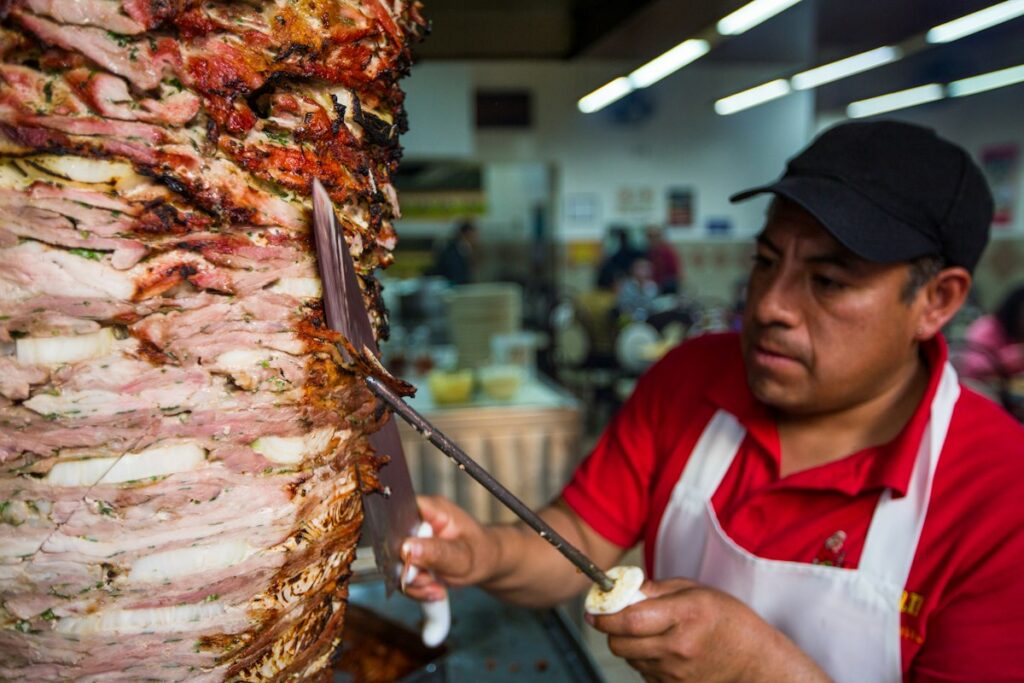
A cook in Mexico City shaves thin curls of marinated pork from a vertical spit and catches them on a small tortilla with one flick of the knife. Ask what street food reveals about a city and that spit is a decent first answer. By the most common telling, it didn’t start out Mexican, and it didn’t start out pork.
The menu is a record of who arrived
A widely repeated account, summarized by Tasting Table, credits Lebanese immigrants in 1930s Puebla with the idea. They roasted lamb on an upright spit, shawarma-style, wrapped it in flatbread, and sold it as tacos árabes. Pork and chile marinades came later, as Mexican cooks made the method their own. The details shift with the teller, and the dates belong to the popular story rather than to any archive.
The pattern is sturdier than any one date. Newcomers bring a dish. The neighbors nudge the seasoning, and the local butcher decides the meat. Eventually somebody else’s technique becomes the default lunch. Read this way, a taco stand is a migration history that happens to come with salsa.
Follow the ingredients back to the market
A guide for small food businesses from the FAO estimates that about 2.5 billion people eat street food every day. It adds that in Latin America those purchases can account for as much as 30 percent of urban household spending. The guide also notes that vendors usually buy in small quantities from nearby suppliers, who buy in turn from local farmers.
That follows from the cart itself. With almost no storage, a vendor buys little and often, so the griddle tends to mirror what the surrounding market had that week. The particular chile or the rolls from the bakery down the block are less a chef’s manifesto than a snapshot of a region’s harvest and wholesale routes.
Where the vendor stands is a policy decision
Singapore offers a well-documented case of a government reshaping how a city eats. The National Environment Agency says hawker centres were built from the 1970s to bring street vendors under one roof, with running water, sewerage, and electricity. Resettlement was completed in 1986. By 2011, the government had recognized that a changing city needed new centres.
The economics are still being worked out. An ABC News report from October 10, 2026, revisits the 1978 move off the street. It notes that about a third of stallholders still pay subsidized rents, some as low as S$192. Newer hawkers bid at market rates, and some centres require stalls to offer a value meal benchmarked at about S$3.50. That cheap plate is a negotiation among rent, heritage, and policy, and the cook is only one party at the table.
New York is having its own version of the argument. In January 2026, the City Council overrode a mayoral veto to pass a vending reform. As 6sqft reported, it opens 2,200 additional applications a year, from 2026 through 2031, for supervisory licenses, the credential a vendor needs to hold a food cart permit. It also provides for 10,500 general vending licenses in 2027. For years, the number of carts on a corner said as much about a permit cap as about appetite.
Reading street food without turning it into scenery
It’s tempting to treat vendors as local color. That skips the interesting part. The person at the griddle runs a small business with suppliers, licensing, inspections, and often rent, and the food carries every one of those constraints.
So watch for details that carry information. Notice who lines up at noon (office workers, students, or mostly visitors with cameras), what gets cooked to order, and whether prices are posted. Check where the stalls cluster, whether around a transit stop, a market hall, or a sanctioned zone, since placement usually traces back to a rule somebody wrote. And if someone offers to share a table, the polite standoff over the last skewer counts as local knowledge too.
When a plate of street food seems almost too cheap, it’s worth working out what holds the price there. Sometimes it’s a family recipe. Just as often it’s a move off the street in 1978, a license cap, or a farmer a few miles out of town.