At lunchtime in a busy Singapore hawker centre, a packet of tissues on an empty table is widely understood to mean the seat is taken. Someone has claimed it and gone to queue for chicken rice. No sign explains this. The tissues belong to a seating system built on communal tables, and regulars give it about as much thought as their spoons.
That ease is the interesting part. Some food cultures happily seat strangers elbow to elbow, while others treat a table for two as private property. No single tradition explains it. Shared tables grew out of practical pressures like crowded rooms, loyal regulars and worries about hygiene, which hardened into custom and, much later, into a restaurant design choice.
When the whole room is shared, so are the tables
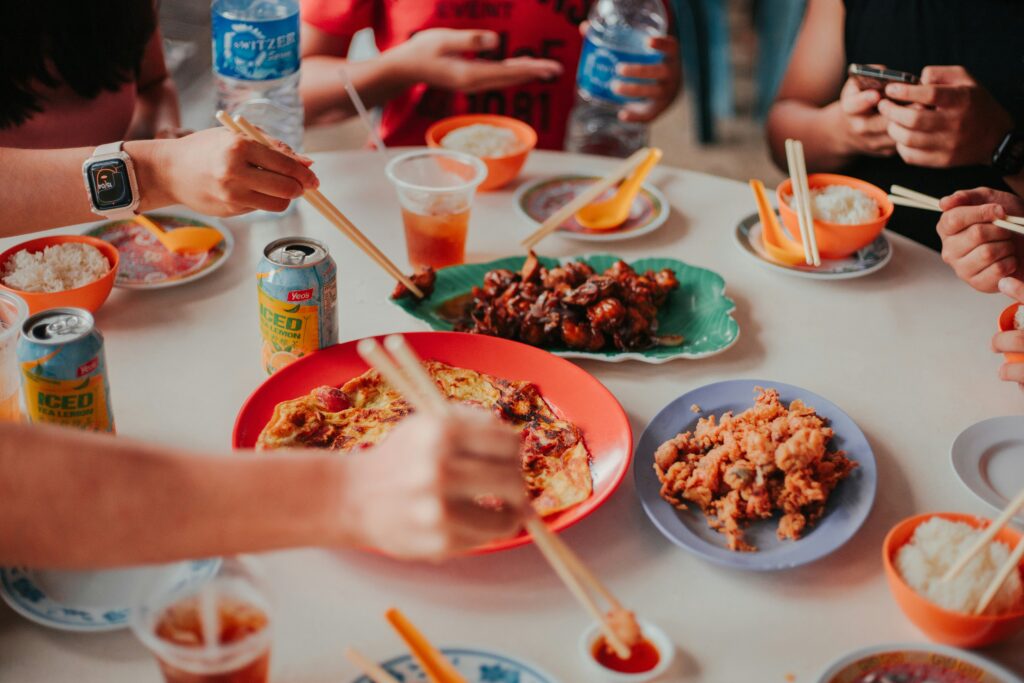
A hawker centre is less a restaurant than a cluster of them. Many stalls specialize in a dish or two, and all of them share one big seating area. A family might buy noodles from one stall, curry from another and sugarcane juice from a third, then reconvene with three trays and a brief negotiation over who carries the soup. Tables tied to individual stalls would break that up. Shared seating is what lets laksa and roti prata land on the same tabletop, both still steaming.
The tissue packet works only because everyone knows the rule. A common table runs on etiquette that isn’t optional.
Some shared tables are about who belongs
In Germany the logic runs almost the other way. As a 2024 NPR piece explains, Stammtisch means “regulars’ table.” Traditionally it was a corner table in the village bar, held for elders and regulars. Its job was never to squeeze more people in. It marked who belonged.
French offers a phrase that has wandered somewhere else entirely. Table d’hôte translates literally as “the host’s table,” yet on most menus today it simply signals a fixed-price set meal. The words point to a table, and the menu points to a price.
Sharing the dishes is not the same as sharing the bench
The Chinese banquet table is another custom again. Dishes travel around it, but the people seated there usually arrived together. Strangers aren’t the point. The turntable in the middle looks as if it has always been there, and Smithsonian suggests otherwise. In 1915, the doctor Wu Lien-teh described a revolving tray he presented as a hygiene measure. Separately, the magazine reports, the first known revolving dining table in China turned up at a 1917 conference in Canton. An expert on Chinese antiques told Smithsonian he knew of no example from before the 20th century.
So the object many people picture when they think of passing dishes at a Chinese meal is a fairly recent arrival. As far as this record shows, it was first argued for on hygiene grounds rather than hospitality. The conviviality came later, one spin at a time.
The communal table as a design decision
In Western restaurants, the communal table is often a choice that travels from one dining room to the next. Le Pain Quotidien says its first bakery, on Rue Antoine Dansaert in Brussels, was furnished with a long table from a flea market, and that table became the brand’s first communal table.
The idea returns in waves. In January 2026, Washingtonian reported on a Resy-commissioned survey in which 90 percent of Gen Z respondents favored communal tables, compared with 60 percent of baby boomers. The same story looked at Tapori in Washington, D.C., which is built around a 20-seat table. Brian Miller, a designer the magazine spoke with, estimated that communal seating suits only about 5 percent of restaurant spaces. Where it does fit, he said, the table needs to be “bigger than any one conversation.”
That phrase explains the whole spectrum. Put six strangers at a small shared table and it feels like a dinner party without a host, where everyone hears everything and nobody knows who should pass the bread. Lengthen the table, or widen the room to hawker-centre scale, and it starts behaving like a public square, where joining in and keeping to yourself are equally fine. Seen that way, the tissue packet is less a quirk than a small piece of public infrastructure.